

Digital Service History Lesson
In the last several years, there has been something of a revolution in government technology. As of 2010, government tech efforts were typically lagging private industry. Through various contributing factors (including software vendors and contractors trying to maintain their income), most agencies followed a waterfall methodology and relied on “safe” enterprise technology stacks (Oracle, IBM, Microsoft, etc.). They largely missed out on the rise of agile methods, human-centered design, open-source technology, and cloud platforms. Various efforts and events helped to set a new precedent and tone. Note: there were many organizations and individuals within government that were an exception to this, but they were a too-small minority.
An Abridged History, Part 1
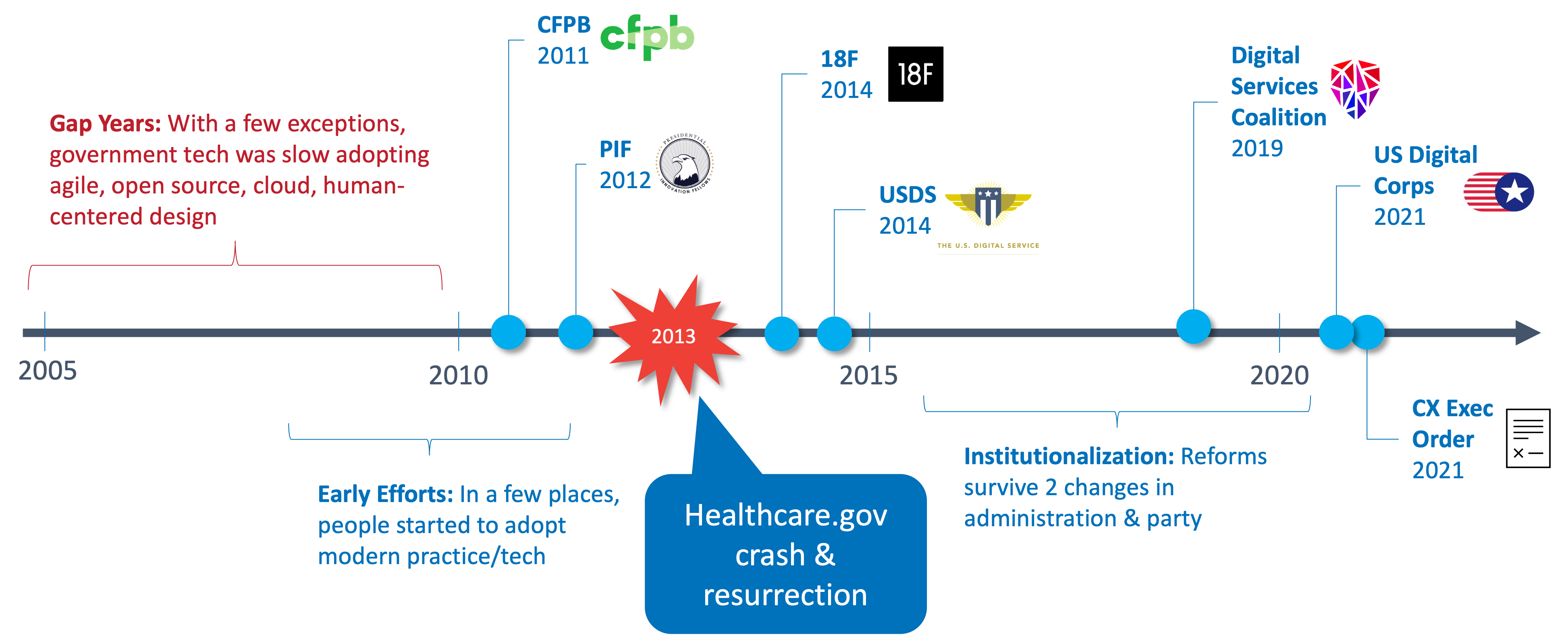
- Some agencies stepped forward on their own. The CFPB was a new agency started in 2011 and brought in modern practice and tech from the start. HHS hired Todd Park as CTO in 2009 to bring Silicon Valley innovation methods (e.g., Lean Startup) to the agency. USCIS leaned hard into agile and cloud after a massive $1 billion failure trying it the traditional and “risk averse” way.
- The Presidential Innovation Fellows (PIF) program was founded in 2012 to bring in new thinking into government via rotating fellows embedded with government agencies.
- Healthcare.gov famously launched and crashed in 2013. This was a pivotal moment as it illustrated both the perils of traditional IT and contracting approaches and the promise of modern methods. Both the "crash" and "rescue" recieved a great deal of attention and press.
- 18F was launched in 2014 as something of an outgrowth of the PIF program – making a more permanent consulting capacity by and for government.
- USDS launched later in 2014 essentially to make the Healthcare.gov rescue a permanent capability. If small teams of talented technologists can help recover, why not have them advise and support other key efforts to improve services and avoid failures.
PIF, 18F, and USDS are well-established and have survived 3 presidential administrations of alternating parties. Many agencies have adopted their own digital service teams. Agile, open-source, and cloud have become the norm rather than the exception. UX or human-centered design are often part of RFPs. The revolution has succeeded in creating the desire for modern solutions, but not always the practice. Many agencies want to be agile or want to adopt human-centered methods, but are still overcoming old habits.
An Abridged History, Part 2
The 2nd Trump adminsitration brought substantial disruption in early 2025. The US Digital Service was repurposed as the US DOGE Service, with nearly 100% turnover of staff. 18F was shut down entirely. Agencies such as CFPB, USAID, and Department of Education were substantially gutted overall. Many agency-level technologist staff were removed as part of mass firings of probationary employees in an effort to reduce overall headcount.
Despite that disruption, the vast majority of government missions continue and the same core need remains. Technology can help government serve people more effectively and efficiently. We are still a part of making that happen.
Resource: Recoding America
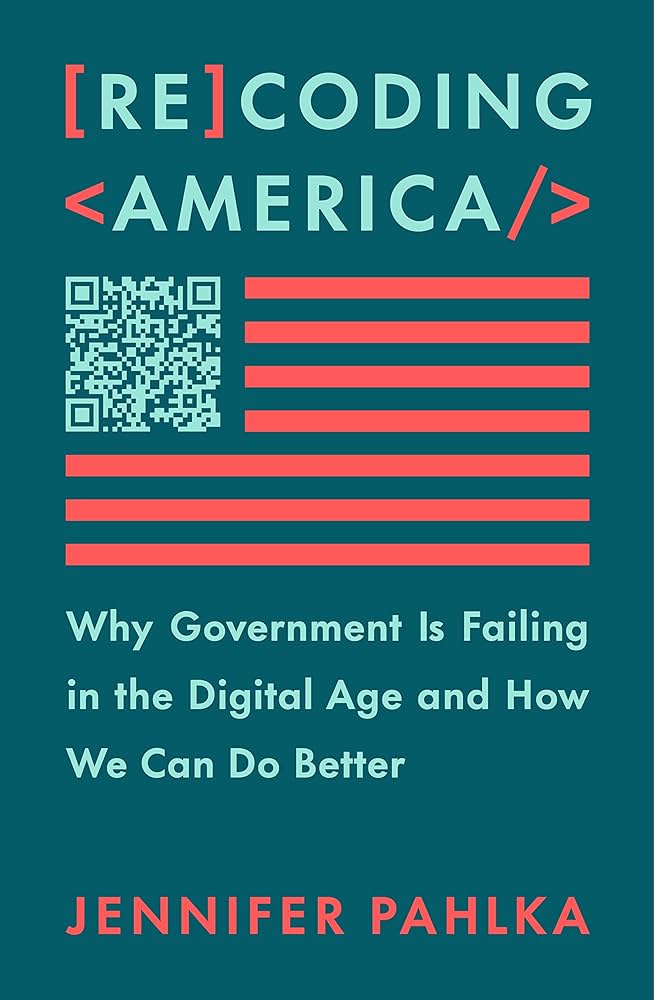
The Jennifer Pahlka book Recoding America didn’t invent our field but does a fantastic job of defining the Pluribus target customer: change agents who want to implement effective government policies and services in the digital age. We don’t exist to implement all of the ideas in this book, but we do provide a targeted set of capabilities for the government leaders who are driving that change.
Every leader in Pluribus should:
- Read the book (and listen to one of the many interviews about the ideas in the book)
- Understand and be conversant in the core concepts of the book and where we can make a difference
- Readily articulate how your work makes a real impact on government service outcomes